Innovating and Creating with Science & Technology
At the Future Fusion level, learners dive into advanced scientific concepts and begin applying them through design, innovation, and emerging technologies. This level focuses on real-world problem-solving, preparing kids for deeper learning and future career paths in science and technology.
PHYSICS covers detailed concepts like energy transfer, pressure, advanced motion, sound waves, light behavior, and basic thermodynamics. Students begin to understand abstract scientific laws and their applications.
CHEMISTRY expands on chemical bonding, reactions, acids and bases, and the periodic table. Learners perform experiments to observe, analyze, and draw conclusions from complex interactions between substances.
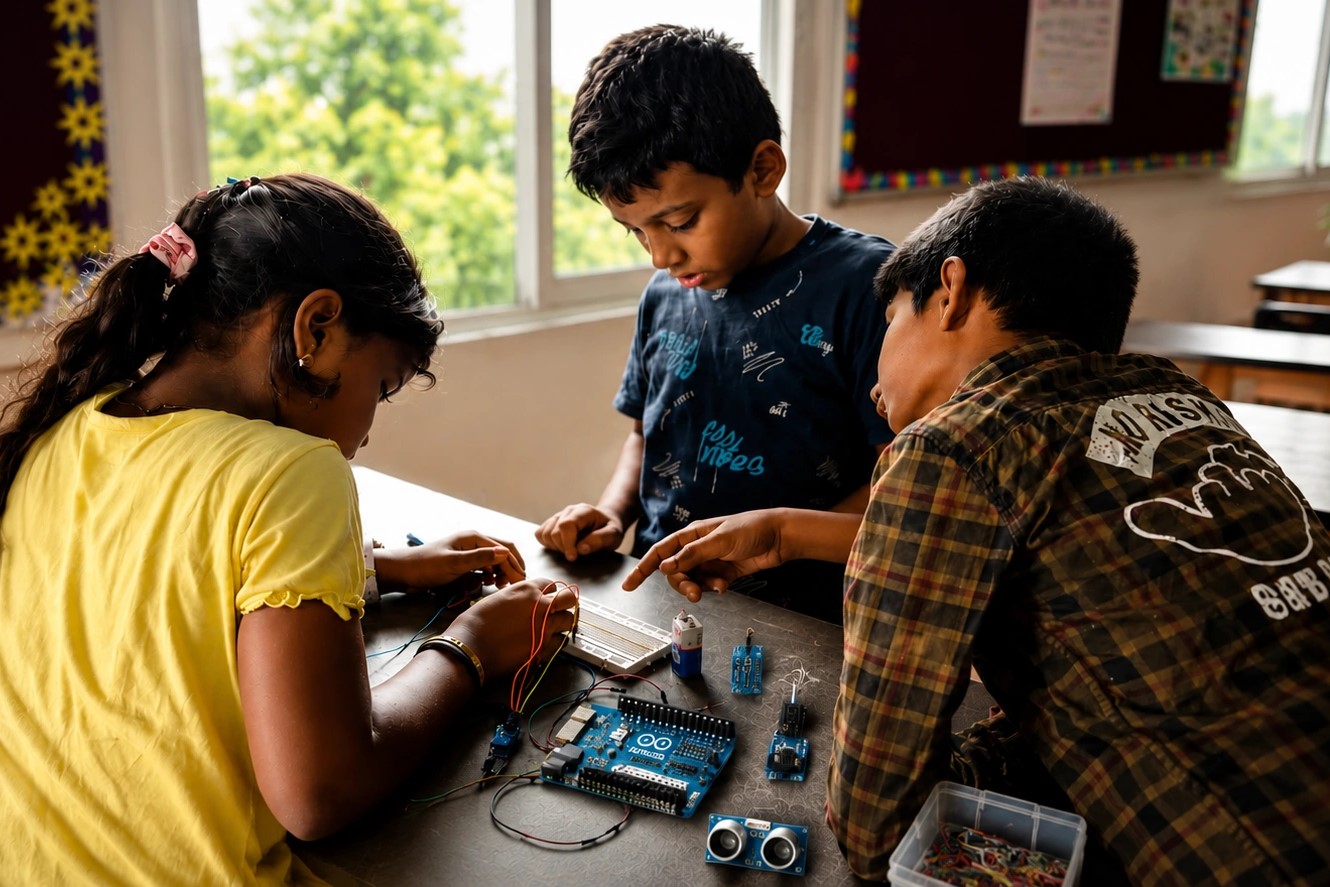
ELECTRONICS focuses on designing more complex circuits, understanding voltage, resistance, and using sensors to build systems that respond to input. This lays the foundation for robotics and automation.
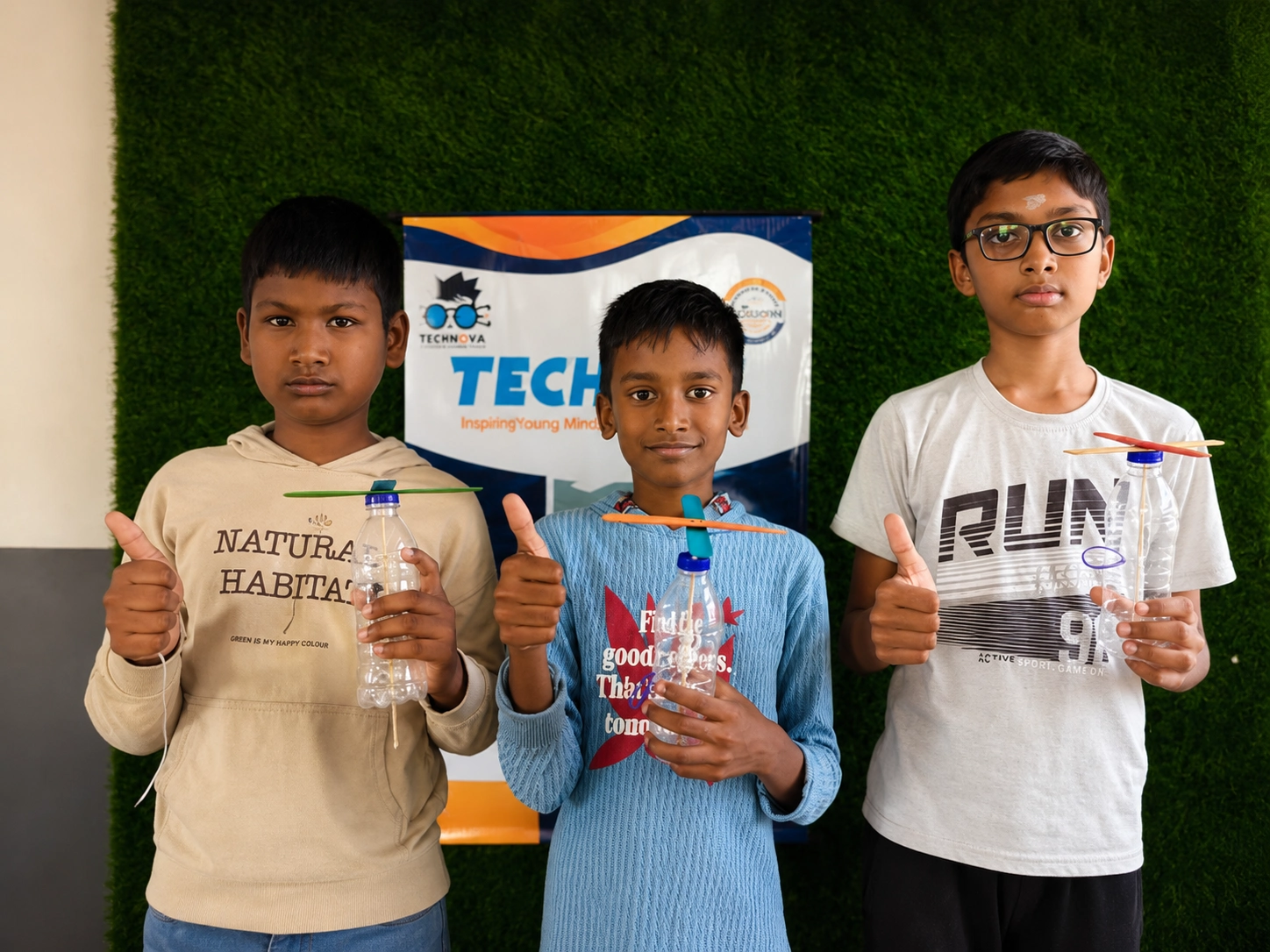
ROCKET SCIENCE studies propulsion systems, propulsion, aerodynamics, and multi-stage launch mechanisms. Students begin to apply scientific principles to build and test prototypes and study real aerospace developments.
ENGINEERING involves mechanical systems, structural design, prototyping, and real-world problem-solving using tools and calculations. Emphasis is placed on planning, iteration, and functionality.
ARTIFICIAL INTELLIGENCE (AI) includes algorithm development, data-based decision making, and real-life applications like smart systems and automation. Children learn the foundational logic behind how AI works.
3D DESIGN Projects introduce students to digital modelling tools, design thinking, and product prototyping. They learn how to conceptualize, draft, and visualize scientific or engineering ideas using software tools.
Highlights
- Advanced science made hands-on and approachable
- Includes robotics, AI, and 3D design—cutting-edge exposure
- Strong integration of creativity and logic
- Real-world project development approach
- Prepares for higher studies and STEAM-related career awareness
- Dual-language support (Tamil & English) for deeper understanding
Learning Outcomes
- Apply scientific methods to solve real-world problems
- Master the principles of physics, chemistry, and electronics
- Understand systems thinking and automation using AI logic
- Develop and design working models and simulations
- Learn fundamentals of digital design and engineering thinking
Impact On Children’s Lives
- Instills innovation, independence, and self-motivation
- Builds a strong portfolio for academic and career exploration
- Enhances digital literacy and technological fluency
- Encourages leadership and collaboration in group projects
- Inspires long-term interest in STEAM education and problem-solving for social good